

An ACIM Exegesis on the Exodus
What you are about to read are my musings on a key moment in the biblical story of Moses. Now before you go ahead and make up your mind about Moses and the Bible, pause for a moment… be still. Allow all preconceived notions and expectations to fall away. And from this still place within, prepare to receive a different, more illuminating, view of this age-old legend.
…what Moses is essentially saying is: “Stand still and shut up!” Stop misusing the power of your thoughts and words to miscreate a fearful world for yourselves!
The beautiful thing about the Bible is that it can be interpreted on many different levels, with one form of interpretation most especially standing out above the rest. The sages of Israel and the early luminaries of the Church taught the exceeding importance of seeing the Scriptures through the lens of allegory. One allegorist who immediately comes to mind is my favorite Church Father, Origen of Alexandria. Although considered the greatest biblical scholar and theologian of the early Church, he was later branded a heretic for his views on reincarnation and the preexistence of the soul. That aside, Origen believed that the true meaning of the Bible can only be found through an allegorical interpretation. For him, it was the key to unlocking the deepest truths that were hidden below the literal level of the stories.
al-le-go-ry
the expression by means of symbolic fictional figures and actions of truths or generalizations about human existence
Merriam-Webster
Origen’s view, in some ways, is echoed in what the great Swiss psychologist, Carl Jung believed about the language of myth. He said that mythology, and by extension sacred Scripture and Alchemy, used symbolic language to convey the transcendental and numinous qualities of the soul and Spirit, which could never be adequately expressed in a simple literal way.
This point of a more expanded view given in allegory and how it contrasts with the restricting view of literalism was not only a heated topic of debate and a major divide among the early Church Fathers about how to interpret the Bible, on another level it gets to the heart of our Bible story about the Exodus.
You see, the two main characters, Pharaoh and Moses, represent two different ways of being. Pharaoh, like the literal approach, wants to confine and control life within limitation, enslave it, much like a serpent constricting it within his coils. The King of Egypt is very much akin to what A Course In Miracles refers to as “the ego.” Moses, on the other hand, represents that part of human consciousness that has surrendered to God and has realized the true I Am, what the Course calls “right mindedness.” He looks to protect and liberate life from all the shackles of illusion. Like the allegorical approach, he is not held down by the rigid rules and mores of his time and culture. His thought system is set within the archetypal, universal, and multidimensional.
Now lets turn to the tale. Moses, along with the children of Israel, are standing at the edge of the sea. The ten plagues are behind them, including the death of the firstborn of Pharaoh. It was with that final blow that the arrogant heart of the oppressive ruler of Egypt was broken and he released Moses and his followers “to go serve God.” Like all good megalomaniacs he reneges, marshals his forces, and heads out in hot pursuit of the newly freed slaves who are staggering and stumbling toward this seemingly uncrossable threshold.
When Pharaoh got closer, the Israelites looked up, and there were the Egyptians marching after them, and they were terrified. The Israelites cried out to the LORD, and they said to Moses, “Is it because there are no graves in Egypt that you have taken us away to die in the desert? What in the world have you done to us by bringing us out of Egypt? Isn’t this what we told you in Egypt, ‘Leave us alone so that we can serve the Egyptians, because it is better for us to serve the Egyptians than to die in the desert?’”
Exodus 14. 10-12
So this is where the allegory kicks in. What I mean by that is that this entire story is to be internalized as a map of consciousness that details the very subtle, often unconscious, dynamics that we face when transitioning from ego identity to spirit identity.
Remember, Pharaoh in this story perfectly portrays the nature of ego. He denies God’s existence (Ex.5.2), makes the lives of His people “bitter with hard bondage” (Ex.1.14), and uses them to build cities dedicated to his narcissistic self-glorification (Ex.1.11).
The Israelites, seen allegorically, can represent the power of our mind, what Freud and Jung called “psychic energy” or libido, which has fallen into ego/body identification and is now under the tyranny of serving the ego and building its kingdom of darkness, also referred to in ACIM as “miscreation.” As the Course states, “If [the mind] does not freely elect to [serve the Spirit], it retains its creative ability, but places itself under tyrannous rather than authoritative control. As a result, what it makes is imprisonment, because such is the dictates of tyrants” (T-1.43.3).
As was mentioned earlier, Moses is that part of the mind that chooses to serve the Spirit and now must motivate these unruly mental sets (the Israelites) that have been accustomed to life under the ego’s cruel regime. He certainly has his job cut out for him, as the above passage shows, and, truth be told, so do we.
Mental sets represent a form of rigidity in which an individual behaves or believes in a certain way due to prior experience.
Wikipedia, Rigidity (psychology)
If you are reading this blog post with any level of interest it means that you have, to some degree, awakened your inner Moses, and are, in some way or another, preparing for your Exodus out of the empire of the ego. Once you have decided to serve God’s plan instead of the ego’s, you are no longer a compliant and obedient slave and will now be considered an “enemy of the state.” The ego, like Pharaoh in the passage quoted above, will come for you. This is what the the Course means when it says: “The ego [Pharaoh] will begin to attack your motives [the Israelites] as soon as they become clearly out of accord with its perception of you. This is when it will shift abruptly from suspiciousness to viciousness…” (T-9.VII.4). Pharaoh and his army of limiting beliefs and disturbing emotions, shameful memories, unforgiven grievances, along with past traumas, fears, and anxieties will seek to drag you back into body identification or Egypt. (It should be noted here that for centuries Jews, Christians, and Gnostics have understood Egypt to be a literary symbol for “the flesh”).
Notice how the Israelites respond after “looking up” and seeing the King of Egypt headed their way (Ex.14.10). First, they cry out to God and then turn their ire onto Moses. Because of their rigid mental set they can only see death as the possible outcome. Pharaoh is too strong to be overcome. They are too weak and only know how to submit to his power and control. Their cry to God lacks any opening for Him to act in the situation because they have made up their minds as to what the situation means and how this will inevitably end in their utter demise. In their learned helplessness their minds are flooded with fear, and in this state of mind miracles are impossible. Now Moses is the bad guy. He’s the one that messed up their lives. They would have preferred to remain slaves to the Egyptians rather than “die in the desert.”
Perhaps you can relate to this, I know I can. There were times before I got my spiritual sea legs that I doubted “my Moses.” It normally occurs precisely at this very challenging stage of transitioning, where the world of the ego still has a strong influence over our desires, imagination, and identity. The life of the Spirit is still more of a concept than a living truth to be relied upon and trusted in. We have grown used to our chains and the cold comfort of knowing what tomorrow will bring.
Moses brings the Israelites to the brink of total annihilation, ego death. His message threatens everything that they have come to believe is real. This is why he is hated. However, what the Israelites are not aware of is that this seeming tragic psychological death will be immediately followed by a magnificent rebirth in consciousness, which allows for a direct encounter with God. It is interesting to point out here that the body of water mentioned in the Exodus story is NOT the Red Sea. It is referred to in the Hebrew as, yam suf, “the Sea of Ending.” For the Israelites, this is the end of life as they’ve known it. They stand at the boundary between the worlds. This is the Passover, the crossing point that transports them from slavery to freedom, darkness to light. It is the place where a miracle is about to happen.
Principle 13:
A miracle is a beginning and an ending. It thus abolishes time. It is an affirmation of rebirth, which seems to go back but really goes forward. It undoes the past in the present, and thus releases the future.
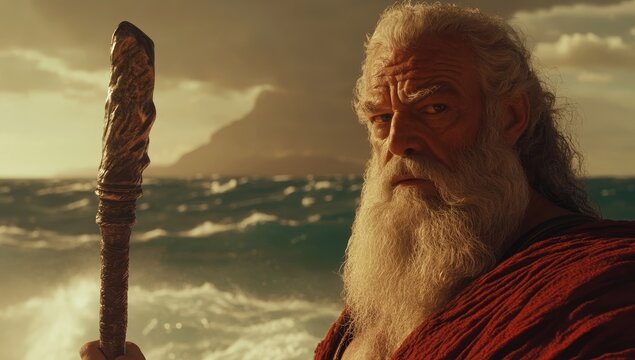
Moses said to the people, “Do not fear! Stand firm and see the salvation of the LORD that he will provide for you today; for the Egyptians that you see today you will never, ever see again. The LORD will fight for you, and you can be still.”
Exodus 14.13-14
In order for a miracle to take place in our lives, we would do well in following the inspired teaching that the Master Moses gave to the Israelites. First off, “Do not fear!” According to A Course In Miracles, if the mind is in a state of fear miracles become impossible. This is because the mind, through free will, has elected to make the fear real, thus rejecting the power of the miracle, which denies that fear exists. In the case of our story, the Israelites already determined that they were about to die at the hand of Pharaoh’s army, something that they declared would happen long before leaving Egypt, “Is not this the word that we did tell thee in Egypt…?” (Ex.14.10). This is a warning to all of us: Beware of how you use your “word.” “Death and life are in the power of the tongue: and they that love it shall eat the fruit thereof” (Proverbs 18.21). Our words have power, and as we are seeing in the case of the Israelites they already determined how this situation was gonna go. The Israelites are living into the “word” that they have spoken, “that we should die in the wilderness” (Ex.14.12).
Moses sees a completely different reality. When “God said unto Moses, I AM THAT I AM” (Ex.3.14), that “Word” was a divine revelation. I am sure that the author of Exodus wants us to make a connection between the creation account of Genesis chapter 1 where “God said: let there be light” and creation happened, with the enlightening and recreation of Moses’ consciousness. It’s as if the Spirit once again hovered over the dark waters of Moses’ mind and illuminated it, thereby separating the chaotic waters from the firm and stable dry land. God said to Moses, “I AM THAT I AM.” Moses had the realization that his personal subjective consciousness, his “I am,” is actually a divine creation. It is really God’s I AM. Moses came to experience, to some degree, what Jesus would later declare: “I and the Father are one.” There is no separation between my I am and God’s I AM. But the only way to enter into this communion with God is to “be still” and listen for the “still small voice.”
It’s as if the Spirit once again hovered over the dark waters and illuminated them and thereby separated the chaotic and turbulent sea from the still and stable dry land, but this time it all occurred within the very mind of Moses! The undoing of fear and the restoration of peace and stillness is the work of the Spirit, which we all eventually must undergo. “It is a required course.” Now Moses is called upon to share what he has received from God and extend it to the Israelites, who are also confronted with the primordial fear of the dark waters, along with the viciousness of the ego and its minions.
What is the first thing that the Master says? “Fear ye not, stand still and see the salvation of the LORD” (KJV). The reason why “the LORD” is in all caps is because it is a replacement for the Hebrew name for God, YHVH. It just so happens that this Name is a form of the verb “to be,” and it means “He who was, He who is, and He who will be.” It is also the same verb used in the name I AM. So what Moses is essentially saying is: “Stand still and shut up!” Stop misusing the power of your thoughts and words to miscreate a fearful world for yourselves! Once you quiet down and enter the stillness, you will “see” the healing power of the divine I AM at the very heart of your own consciousness. You will hear and abide in the Word, and its light will part the waters of chaos for you and vanquish the once totalizing authority that the ego exercised over your life, “and ye shall hold your peace” (Ex.14.14).
I think I will leave it there for now. I hope that this has proved helpful for you and perhaps given you a new perspective on this episode in the story of Moses. So much more can be said but I have gone on long enough, maybe too long. If you stayed with me all the way to the end, I thank you for your time. If you feel so inclined and would like to leave a comment, please feel free to do so. I look forward to reading your feedback.

Leave a Reply
You must be logged in to post a comment.